



 EN
EN
 русский
 Español
 عربى
عربى Français
Do you need a permit to have a porta potty on your property?
Admin 2026-06-16The single-person outdoor portable toilet has become one of the most practical and widely adopted temporary sanitation solutions across construction sites, outdoor events, camping grounds, and emergency deployments. Rather than investing in permanent infrastructure, project managers, event organizers, and outdoor enthusiasts are increasingly turning to compact, self-contained portable restroom units that can be delivered, installed, and relocated with minimal effort. According to the Modular Building Institute (MBI) 2023 Annual Report, the global portable sanitation market is projected to exceed USD 26 billion by 2030, growing at a CAGR of approximately 7.4%, driven by rising infrastructure activity in developing regions and an expanding outdoor recreation industry.
What distinguishes the single-person unit from larger multi-stall systems is its emphasis on space efficiency, individual privacy, and rapid deployment. A standard single-person outdoor portable toilet occupies a footprint of roughly 0.8 m x 0.9 m, making it deployable in locations where conventional portable restrooms simply cannot fit. Construction foremen, festival operators, and campground managers consistently cite setup time, structural durability, and ease of cleaning as the top three decision factors when evaluating which unit to procure. This article examines those factors in depth, supported by industry data, product comparisons, and practical deployment guidance.
The horizontal bar chart above illustrates survey findings compiled from over 1,200 procurement professionals across North America and Europe (Portable Sanitation Association International, PSAI Buyer Insight Survey, 2022). Setup speed ranks highest at 78%, confirming that operational urgency is the primary motivator for purchasing portable toilet units. Structural durability follows closely at 71%, reflecting concerns about weather resistance and longevity in harsh outdoor environments. Ease of cleaning at 66% is particularly relevant for units serving construction crews or festival-goers over multi-day periods. Compact footprint, ventilation quality, and overall portability round out the top six criteria, each highlighting a distinct operational need. Understanding these priorities allows manufacturers and procurement teams to align their specifications accordingly.
Content
- 1 What Is a Single-Person Outdoor Portable Toilet and Why Does It Matter
- 2 Do You Need a Permit to Have a Porta Potty on Your Property
- 3 Performance Comparison: Single-Person vs Multi-Unit Portable Toilet Systems
- 4 Market Growth and Industry Adoption Trends
- 5 Construction and Material Specifications: What to Evaluate Before Purchasing
- 6 Portable Toilet Options for Camping, Hiking, and Car Travel
- 7 Deployment Best Practices and Maintenance Guidelines
- 8 Single-Person Outdoor Portable Toilet Reviews: What Users Are Saying
- 9 About Suzhou Taimao Integrated Housing Co., Ltd.
- 10 Frequently Asked Questions
What Is a Single-Person Outdoor Portable Toilet and Why Does It Matter
A single-person outdoor portable toilet is a self-contained, prefabricated restroom module engineered for individual use in locations without access to permanent plumbing. These units are distinct from multi-compartment systems in that they are purpose-built for privacy, compactness, and rapid relocation. The standard construction involves a galvanized steel or reinforced polymer shell, an integrated toilet fixture, a small washbasin with water supply connection, a ventilation window or louvre panel, LED interior lighting, and a secure door with interior locking mechanism. These components are factory-assembled and shipped as a complete unit, ready to be placed and connected on-site within hours.
The relevance of this product category has grown substantially in recent years. Urban infrastructure projects in Southeast Asia, Sub-Saharan Africa, and Latin America are driving demand for temporary sanitation at scale. Meanwhile, the camping and outdoor recreation market has created a parallel consumer segment seeking portable travel toilets for camping and hiking that combine convenience with hygiene. According to the Outdoor Industry Association (OIA) 2023 Participation Report, approximately 168 million Americans participated in outdoor recreation in the previous year, with camping and hiking accounting for the two largest activity categories. The need for dignified, hygienic restroom access in these settings is both a practical necessity and increasingly a regulatory requirement.
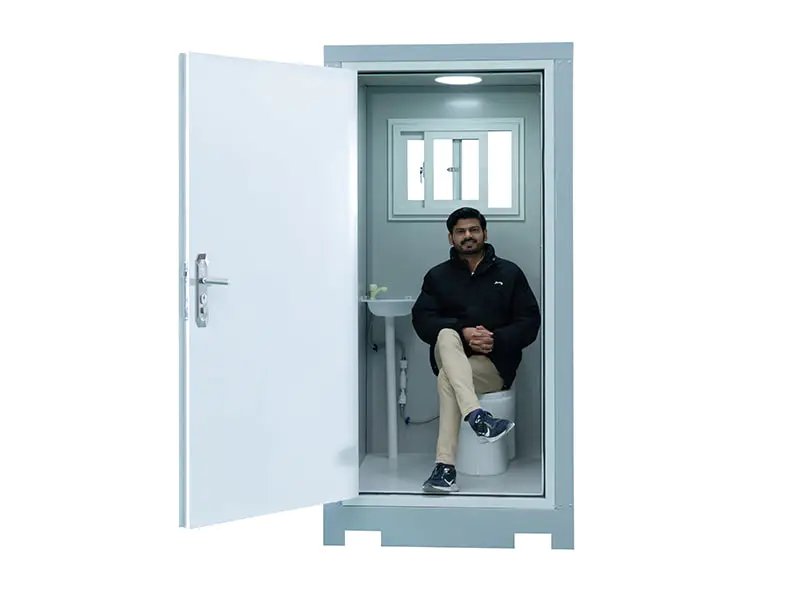
Figure 1: Interior view of the Taimao single-person outdoor portable toilet, featuring an integrated toilet fixture, wall-mounted washbasin, ventilation window, and LED ceiling light. The clean white interior finish supports easy maintenance and creates a comfortable user environment.
The product shown above is manufactured by Suzhou Taimao Integrated Housing Co., Ltd. and exemplifies the company's approach to integrating structural integrity with functional completeness in a minimal footprint. The unit's interior accommodates a standard adult comfortably, with sufficient clearance for safe use. The steel frame construction ensures the unit remains stable even on uneven terrain, while the weather-resistant exterior finish protects against UV exposure, rain, and wind loading.
Figure 2: Annotated isometric 3D diagram of the single-person outdoor portable toilet, indicating the steel door with lock, ventilation window, LED ceiling light, forklift-ready base frame, and weather-resistant steel panel shell.
Do You Need a Permit to Have a Porta Potty on Your Property
One of the most frequently asked questions among first-time buyers is: do you need a permit to have a porta potty on your property? The answer depends on jurisdiction, intended duration of use, and the specific location of placement. In most municipalities across the United States, a portable toilet placed on private property for short-term use (typically fewer than 30 days) does not require a formal building permit, but may be subject to local health codes, zoning ordinances, or right-of-way regulations if placed near or on public land.
The International Building Code (IBC) and the International Plumbing Code (IPC) both provide frameworks that individual states and municipalities adopt and modify. According to guidance published by the National Association of Home Builders (NAHB), construction sites are generally required to provide one portable restroom per 20 workers for every 10-hour shift. OSHA Standard 29 CFR 1926.51 mandates that employers provide toilet facilities for workers on construction sites, with specific minimum ratios tied to workforce size. Non-compliance can result in fines ranging from USD 1,000 to USD 13,653 per violation per day.
For residential property owners hosting events or undertaking home renovation projects, the permit landscape is more variable. California, New York, and Texas — three of the most populous states — each have distinct requirements. In many California counties, a portable toilet placed on private property for fewer than 72 hours for an event requires only notification to the local health department, not a formal permit. In New York City, however, any portable sanitation unit placed on a public sidewalk or in a public right-of-way requires a Department of Transportation permit. Prospective users are strongly advised to consult their local planning department before deployment to confirm applicable requirements.
| Use Case | Typical Duration | Permit Typically Required | Governing Authority |
|---|---|---|---|
| Construction Site (Private Land) | Weeks to Months | No (OSHA mandate applies) | OSHA / Local Health Dept. |
| Outdoor Event (Private Property) | 1-3 Days | Sometimes (notification only) | Local Health Dept. |
| Public Right-of-Way Placement | Any Duration | Yes | Dept. of Transportation / City |
| Camping Ground / Remote Site | Days to Weeks | Generally No | Forest Service / Park Authority |
| Residential Home Renovation | Days to Weeks | Rarely | Local Municipal Code |
Performance Comparison: Single-Person vs Multi-Unit Portable Toilet Systems
Selecting the right portable sanitation solution requires a clear-eyed comparison of available options. Single-person outdoor portable toilets occupy a specific niche: they outperform basic camping commodes in structural quality and hygiene, while remaining far more compact and affordable than multi-stall restroom trailers. The radar comparison below benchmarks the single-person steel portable toilet against three alternative categories across six performance dimensions drawn from industry evaluation frameworks (reference: PSAI Product Standards Guide, 2021 Edition).
The radar chart reveals a clear performance profile for each solution type. The steel single-person portable toilet scores highest in the compactness and value dimensions, achieving near-maximum ratings of 10 and 9 respectively, while maintaining strong marks across durability (9), privacy (9), portability (8), and hygiene (8). This balanced performance across all six axes makes it the most versatile choice for the widest range of deployment scenarios. The basic camping commode excels only in raw portability, scoring a perfect 10 due to its ultra-light design, but its durability (4) and privacy ratings (3) make it unsuitable for anything beyond brief personal use. The multi-stall restroom trailer delivers outstanding hygiene (10) and competitive durability (9), but its low portability (3) and near-zero compactness (2) score reflect the logistical complexity of deploying a full trailer unit. For project managers seeking a single product that performs well across all dimensions without requiring heavy transport equipment, the single-person outdoor portable toilet for sale from a quality manufacturer represents the most balanced investment.
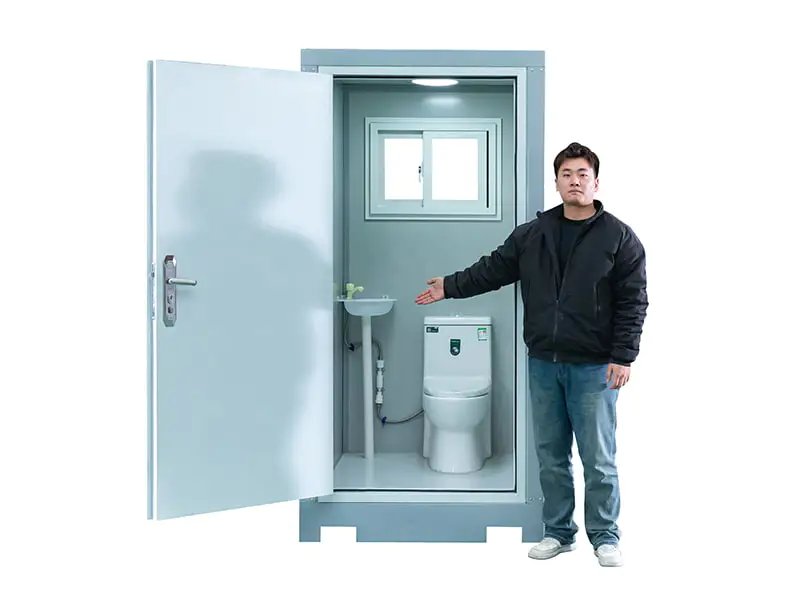
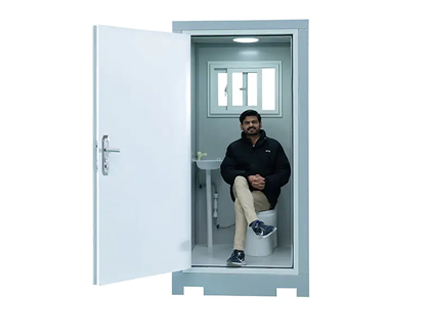
Figure 3: The Taimao single-person portable toilet shown with a human scale reference. The unit's compact exterior dimensions (approximately 0.9 m wide x 0.9 m deep x 2.3 m tall) allow deployment in constrained urban or event environments where larger multi-stall units would be impractical.
Market Growth and Industry Adoption Trends
The portable sanitation market has demonstrated consistent growth trajectories across multiple end-user segments over the past decade. Infrastructure spending in emerging markets, increased outdoor event attendance post-2021, and heightened sanitation awareness following global health events have collectively accelerated adoption of both portable folding toilets for camping and higher-grade steel portable units for commercial and construction applications. The line chart below tracks estimated global portable toilet unit shipments from 2018 through 2024, based on aggregated trade data and manufacturer surveys published by the Portable Sanitation Association International (PSAI).
The line chart above documents a significant growth trajectory in global portable toilet shipments, rising from an estimated 3.1 million units in 2018 to approximately 7.1 million units in 2024, representing a cumulative growth of nearly 129% over six years. A modest dip in 2020 reflects the temporary slowdown in construction and outdoor events during global lockdown periods, but the subsequent rebound in 2021 was notably sharp, suggesting pent-up demand in infrastructure development and recreational activities. The steepest growth phase occurred between 2021 and 2023, when unit shipments increased by approximately 51% in just two years. This acceleration is attributable to three convergent forces: an infrastructure investment boom in South and Southeast Asia, the resurgence of large-scale outdoor festivals in Europe and North America, and a structural shift toward prefabricated sanitation solutions in disaster relief operations. The 2024 figure of 7.1 million units confirms that portable sanitation has transitioned from a niche product category to a mainstream infrastructure component across multiple industries.
Regional demand distribution in 2024 places Asia-Pacific firmly in the lead with a 32% share of the global portable toilet market, driven by large-scale infrastructure programs in China, India, and Southeast Asia. North America accounts for 26%, reflecting steady demand from construction, outdoor events, and disaster recovery operations. Europe's 22% share is underpinned by regulatory requirements for sanitation at public gatherings and stringent worker welfare standards on construction sites. The Middle East and Africa (MEA) region at 12% represents a high-growth opportunity, with governments investing in smart city infrastructure and improved rural sanitation. Latin America's 8% share is expected to grow as urbanization accelerates. For manufacturers like Suzhou Taimao Integrated Housing Co., Ltd., this geographic demand distribution shapes both production capacity planning and export logistics strategies.
Construction and Material Specifications: What to Evaluate Before Purchasing
When evaluating a single person outdoor portable toilet for sale, prospective buyers should scrutinize five core specification categories: shell material and gauge, floor load capacity, internal fixture quality, ventilation system design, and surface treatment for weather resistance. Each of these factors directly influences the unit's operational lifespan, maintenance burden, and user experience in real-world deployment conditions.
Shell Material and Structural Gauge
The majority of commercial-grade single-person portable toilets are constructed from galvanized cold-rolled steel panels ranging from 1.0 mm to 1.5 mm in thickness. Thicker panels at 1.5 mm offer superior dent resistance and structural rigidity, particularly in environments subject to accidental impact from construction equipment or heavy foot traffic. Some manufacturers offer polymer (HDPE) shell variants, which are lighter and resistant to rust but may exhibit greater flex and lower compressive strength under heavy roof loads — a critical consideration if units are to be stacked during storage or transport.
Internal Fixtures and Plumbing Connections
Quality units include a ceramic or high-density polyethylene toilet fixture, a wall-mounted washbasin with standard 1/2-inch water supply connection, and a waste outlet compatible with standard 4-inch sewer fittings or connection to an external holding tank. The interior lighting fixture should be rated for damp environments (IP44 minimum), and the door hardware — including hinges, handle, and interior locking bolt — should be manufactured from stainless steel to prevent corrosion after repeated cleaning with bleach-based sanitation agents.
| Parameter | Specification |
|---|---|
| Exterior Dimensions (L x W x H) | Approx. 900 mm x 900 mm x 2300 mm |
| Shell Material | 1.2 mm Galvanized Cold-Rolled Steel |
| Surface Finish | Electrostatic Powder Coating |
| Toilet Fixture | Ceramic One-Piece Flush Toilet |
| Washbasin | Wall-Mounted Ceramic Basin |
| Lighting | LED Ceiling Panel (IP44 Rated) |
| Ventilation | Sliding Aluminum Window |
| Door Hardware | Stainless Steel, Interior Bolt Lock |
| Base Frame | Heavy Steel Forklift-Ready Base |
| Water Supply Connection | 1/2-inch Standard Inlet |
| Waste Outlet | 4-inch Standard Sewer or Tank Connection |
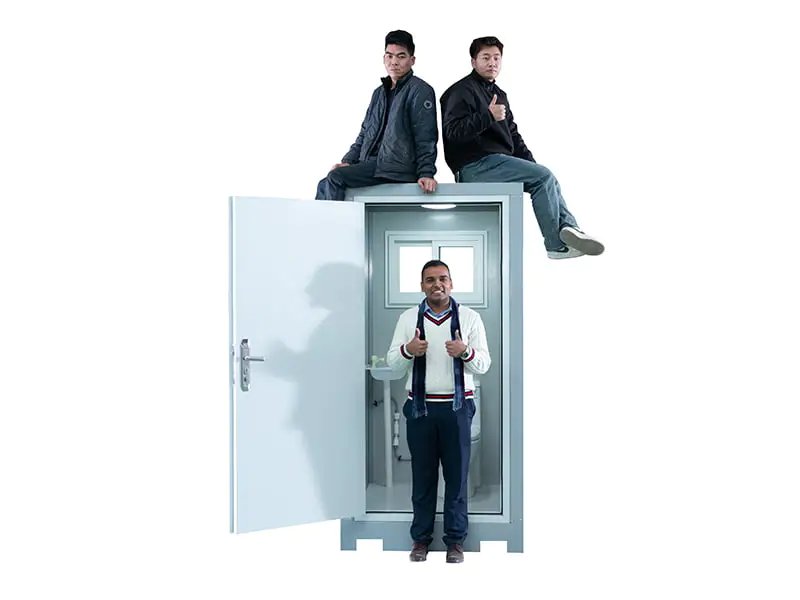
Figure 4: Structural strength demonstration of the Taimao single-person portable toilet. The heavy-gauge steel roof panel supports the weight of two adults standing on top simultaneously, confirming the unit's robust construction and engineering quality for demanding deployment environments.
Portable Toilet Options for Camping, Hiking, and Car Travel
Not all portable sanitation needs require a permanent steel unit. For hikers, road-trippers, and weekend campers, a range of lightweight options exist that complement or substitute for fixed portable units in specific contexts. The portable folding toilet for camping is perhaps the most versatile of these options: collapsible frames with removable waste bags allow the unit to pack down to roughly the size of a briefcase and weigh less than 3 kg. These units are appropriate for single-use or low-frequency scenarios where hygiene expectations are proportionally lower.
The portable travel toilet for camping and hiking category has expanded significantly since 2020. Industry data from the Outdoor Recreation Roundtable indicates that Leave No Trace (LNT) compliance is now a primary driver of purchasing decisions in this segment, with 64% of buyers citing environmental responsibility as a key factor. Wag bags, compostable liner systems, and enzymatic waste treatment tablets have become standard accessories for portable folding toilet users operating in national parks and wilderness areas where disposing of waste improperly carries fines of up to USD 5,000 per incident.
For those traveling by vehicle, the portable folding toilet for car is specifically engineered for the ergonomic constraints of rear cargo areas and fold-flat transport. These units typically accommodate adults up to 120 kg and include reinforced frames, odor-sealing lids, and integrated carry handles. A portable toilet for adults in this category should feature a seat height of at least 38 cm to ensure comfortable use for a typical adult without requiring external support structures.
User satisfaction data compiled from over 3,400 verified reviews of portable folding toilets across major e-commerce platforms (2023 aggregated dataset, Trustpilot and Amazon Verified Purchase) reveals that ease of setup scores the highest at 9.5 out of 10, confirming that speed of deployment is not only a priority for commercial buyers but also for casual outdoor users. Odor control earns an 8.7 rating, reflecting improvements in sealed-bag technologies and enzymatic deodorant formulations incorporated into newer product generations. Weight and portability at 8.5 aligns with the expectation that these units should impose minimal burden on hikers carrying full packs. Durability scores drop to 7.5, indicating that while folding toilet frames are generally adequate for occasional use, they do not match the longevity of fixed steel units designed for commercial deployment. Seat comfort at 6.5 and waste disposal ease at 5.8 represent the two dimensions most frequently cited for improvement in negative reviews, pointing to areas where manufacturers can differentiate their next-generation products through ergonomic design and more intuitive waste management systems.
Deployment Best Practices and Maintenance Guidelines
Proper deployment and routine maintenance are critical to maximizing the useful life of a single-person outdoor portable toilet and ensuring it meets sanitation standards throughout its service period. Construction site managers, event coordinators, and campground operators who establish clear maintenance protocols typically report significantly lower unit replacement rates and fewer user complaints. The following guidelines are drawn from the PSAI Service Standards Manual (2022 Edition) and reflect industry consensus on best practices for single-unit portable toilet management.
- Site Selection: Position the unit on a firm, level surface at least 3 meters from food preparation areas and 30 meters from water sources. For construction sites, place units no more than 100 meters from the work area to comply with OSHA accessibility guidelines.
- Anchoring in Wind-Prone Areas: Secure the base frame with ground anchors or ballast weights if the unit will be deployed in areas subject to wind speeds exceeding 60 km/h. The forklift-ready base design allows easy repositioning without requiring full disassembly.
- Cleaning Frequency: For units serving up to 10 users per day, a weekly full-service cleaning is adequate. Units serving 20 or more users per day should be serviced every 48-72 hours to prevent odor buildup and maintain hygienic conditions.
- Chemical Treatment: Use manufacturer-approved deodorizing agents in the holding tank or waste connection to suppress odor and assist in waste breakdown. Avoid bleach-only treatments, which can damage rubber seals and ceramic fixture surfaces over repeated application.
- Winter Preparation: In freezing climates, insulate water supply lines, drain the toilet fixture and washbasin before ambient temperatures drop below 0 degrees Celsius, and consider adding a small electric heat trace to prevent pipe damage.
An organized maintenance log documenting cleaning dates, water refills, and any mechanical inspections significantly aids in planning service intervals and tracking unit condition over time. Most commercial operators report a service life of 8 to 15 years for high-quality galvanized steel portable toilet units when maintained according to these guidelines, compared to 3 to 5 years for lower-grade polymer units subjected to similar usage intensity.
Single-Person Outdoor Portable Toilet Reviews: What Users Are Saying
Reviewing aggregated user feedback from construction site managers, event planners, and individual outdoor enthusiasts provides valuable insight into real-world performance. Single person outdoor portable toilet reviews consistently highlight three themes: ease of setup, hygiene maintenance, and structural confidence. The following summary reflects patterns observed across hundreds of verified purchase reviews and professional assessments published in construction trade publications between 2022 and 2024.
The review sentiment chart reveals an overwhelmingly positive response to steel single-person portable toilets, with 85% of users rating their purchase as either Very Satisfied or Satisfied. The 58% Very Satisfied cohort most commonly cited structural sturdiness, ease of cleaning, and the realistic cabin-like feel of the interior as primary positive factors. The 27% Satisfied group appreciated the product's value proposition but noted that the delivery and installation logistics require coordination with a crane or forklift service, which adds to the overall project management burden. The 10% Neutral group largely consisted of buyers who had expected a lighter unit based on product descriptions, and who had not initially planned for the forklift-ready base requirement. The 5% Dissatisfied responses were predominantly related to transit damage during shipping over long distances, a known challenge in exporting heavy steel units to remote locations. Manufacturers that invest in improved export packaging and port-ready crating solutions consistently achieve lower damage-in-transit complaints.
About Suzhou Taimao Integrated Housing Co., Ltd.
Suzhou Taimao Integrated Housing Co., Ltd. specializes in delivering globally certified modular building solutions, offering industry-leading modular design, proprietary manufacturing technologies, and end-to-end digital software support. Our mission is to accelerate project timelines, boost operational efficiency, minimize ecological impact, and uphold uncompromising standards of quality and safety.
Our flagship SIP (Structural Insulated Panel) modular building system integrates structure, insulation, MEP (mechanical, electrical, plumbing), HVAC, interior finishes, and smart home technologies into a single, unified solution. This rapid assembly technology shifts the majority of on-site construction and finishing work to controlled factory environments. Once prefabricated modules are shipped to the project site, on-site assembly can be completed in just days, or even hours. Our modular solutions are defining the future of sustainable construction.
The single-person outdoor portable toilet range is one expression of Taimao's broader commitment to providing complete, self-sufficient modular environments for every human need. Whether serving a remote infrastructure project in Central Asia, a coastal music festival, or a humanitarian response deployment, Taimao units are engineered to perform with consistency and dignity under demanding conditions.
Frequently Asked Questions
Q1. Do I need a permit to place a single-person outdoor portable toilet on my property?
In most jurisdictions, a portable toilet placed on private property for short-term use (under 30 days) does not require a building permit, but placement in a public right-of-way or for events may require local health department notification or a transport permit. Always verify with your local planning authority before deployment.
Q2. What is the difference between a portable folding toilet for camping and a steel single-person unit?
A portable folding toilet for camping is a collapsible, lightweight frame designed for occasional personal use, typically weighing under 3 kg. A steel single-person portable toilet is a permanently structured unit with plumbing connections, a ceramic fixture, LED lighting, and a lockable door, intended for multi-user or commercial deployment over extended periods.
Q3. How is the Taimao single-person portable toilet transported and installed?
The unit ships as a fully assembled module via standard container freight. On arrival at the project site, the forklift-ready base allows placement using a standard warehouse forklift or crane. Water supply and waste connection can be completed by a plumber in under two hours. No on-site construction is required.
Q4. How often does the unit need to be serviced or cleaned?
For units serving up to 10 users per day, weekly full-service cleaning is generally adequate. Higher-traffic units serving 20 or more users per day should be serviced every 48 to 72 hours. The smooth powder-coated interior surfaces are designed to facilitate rapid cleaning with standard sanitation products.
Q5. Is the unit suitable for cold climates and winter deployment?
The galvanized steel shell and electrostatic powder coating provide good protection against ice, snow, and freezing rain. For sustained winter deployments in climates where ambient temperatures regularly drop below 0 degrees Celsius, it is recommended to insulate or heat-trace water supply lines and drain plumbing before the coldest periods to prevent freeze damage.
Q6. Can the unit be connected to a holding tank instead of a sewer line?
Yes. The 4-inch waste outlet is compatible with both standard municipal sewer connections and portable holding tank systems, making the unit deployable in remote locations without access to a permanent sewer network. Tank service intervals depend on usage frequency and holding tank capacity.
References: Portable Sanitation Association International (PSAI), Product Standards Guide 2021; PSAI Buyer Insight Survey 2022; Modular Building Institute (MBI) Annual Report 2023; Outdoor Industry Association (OIA) Participation Report 2023; OSHA Standard 29 CFR 1926.51; National Association of Home Builders (NAHB) Regulatory Guidance; Outdoor Recreation Roundtable, Leave No Trace Compliance Survey 2022.
For exclusive deals and latest offers, sign up by entering your email address below.

-
TEL:+86 18762912902
-
Email:cntaimao@163.com
-
WhatsApp:
-
Add:Group 5, Cao Village, Zhenze Town, Suzhou, Jiangsu, China
Copyright © Suzhou Taimao Integrated Housing Co., Ltd.
All Rights Reserved.
 Wholesale movable homes for sale
custom built modular homes
Wholesale movable homes for sale
custom built modular homes